



GAO-26-107874. Published: Mar 27, 2026. Publicly Released: Mar 27, 2026.
Report to the Chair, Committee on Health, Education, Labor and Pensions, U.S. Senate
March 2026
GAO-26-107874
United States Government Accountability Office
Highlights
A report to the Chair of the Committee on Health, Education, Labor and Pensions, U.S. Senate
For more information, contact: Jacqueline M. Nowicki at nowickij@gao.gov
What GAO Found
Teacher professional development is generally associated with higher student test scores, according to meta-analyses GAO reviewed. However, research is mixed about which specific elements of teacher professional development contribute to these higher scores. For example, one of the three meta-analyses that reviewed coaching—one specific element of teacher professional development—found a generally positive association between coaching and student test scores, while the other two meta-analyses found no association.
Most teachers (67 percent) said collaborative learning opportunities with other teachers improved their teaching or their students’ learning, according to a nationally representative RAND survey of K-12 public school teachers from school year 2022–23. Similarly, teachers who responded to GAO’s nongeneralizable questionnaire said collaborative professional development was useful for their classroom teaching. For example, respondents said professional learning communities helped them share resources, exchange ideas, or reflect on teaching practices or issues in the classroom.
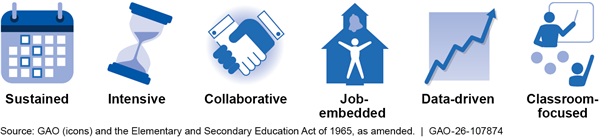
Title II, Part A (Title II-A)—a formula grant program in the Elementary and Secondary Education Act of 1965, as amended (ESEA)—provides federal funds to states and school districts for activities such as teacher professional development. State and local officials from the three states and nine school districts GAO spoke with said that Title II-A’s flexibility and straightforward requirements helped them meet their communities’ educational needs. For example, New Mexico officials described using Title II-A funds to train school district officials on mentoring and recruitment, build a statewide cadre of mentors, and train teachers for leadership and administrative positions. In addition, officials from six of nine school districts reported that requirements applicable to Title II-A—which include that professional development be “data-driven” and “sustained (i.e., not stand-alone, one-day, or short-term workshops),” among others—helped to ensure that professional development is high quality or effective (see figure).
Selected Requirements for Professional Development Under the Elementary and Secondary Act of 1965, as Amended
Why GAO Did This Study
Congress appropriated about $2.2 billion in Title II-A grants each year from fiscal years 2022 through 2024, making it the second largest formula grant program in the ESEA. GAO was asked to review whether Title II-A funds were being used in a manner likely to raise student achievement. This report describes (1) the elements of professional development that research finds to be effective, (2) the elements of professional development that teachers find most useful, and (3) the experiences of selected states and school districts using Title II-A to support effective instruction.
GAO reviewed five meta-analyses that measured the effectiveness of teacher professional development and five U.S. Department of Education studies of randomized controlled trials of teacher professional development programs. In addition, GAO analyzed RAND’s nationally representative American Instructional Resources Survey reports from school years 2022–23 and 2023–24 and developed and disseminated a questionnaire to teachers understand the professional development elements they find useful. GAO also interviewed officials from the New Mexico, Pennsylvania, and Tennessee state educational agencies and nine school districts to understand how these states and districts used Title II-A funds to improve instruction. GAO selected these states and school districts based on characteristics such as the level of state Title II-A funds received, geographic distribution, and urbanicity.
Abbreviations
ESEA–Elementary and Secondary Education Act of 1965, as amended
OESE–Office of Elementary and Secondary Education
Title II‑A–Title II, Part A of the Elementary and Secondary Education Act of 1965, as amended.
This is a work of the U.S. government and is not subject to copyright protection in the United States. The published product may be reproduced and distributed in its entirety without further permission from GAO. However, because this work may contain copyrighted images or other material, permission from the copyright holder may be necessary if you wish to reproduce this material separately.
March 27, 2026
The Honorable Bill Cassidy, M.D.
Chair
Committee on Health, Education, Labor and Pensions
United States Senate
Dear Mr. Chair:
Title II, Part A (Title II‑A)—the second largest formula grant program in the Elementary and Secondary Education Act of 1965, as amended (ESEA)—provides federal funds to states and school districts for activities such as teacher professional development and efforts to improve teacher recruitment and retention. Congress appropriated about $2.2 billion in Title II‑A grants each year from fiscal years 2022 through 2024. Professional development—the most common use of Title II‑A funds—is an integral part of school and district strategies for providing educators with the knowledge and skills they need to help students succeed academically. Further, Title II‑A specifies that certain professional development activities funded with Title II‑A dollars must be evidence-based.[1] Additionally, under the ESEA, professional development must be sustained (i.e., not stand-alone, one-day, or short-term workshops), intensive, collaborative, job-embedded, data-driven, and classroom-focused, among other requirements.[2]
You asked us to review whether Title II‑A funds are being used in a manner likely to raise student achievement. We examined (1) the elements of professional development that research finds to be effective, (2) the elements of professional development that teachers find most useful, and (3) the experiences of selected states and school districts using Title II‑A to support effective instruction.
To identify the elements of professional development research finds to be effective, we reviewed five meta-analyses that measured the effectiveness of teacher professional development. We selected these meta-analyses based on their recency (published 2015–2025), the outcomes they measured (student test scores), the populations they studied (K-12 teachers), and the quantitative methods of the studies they analyzed (experimental and quasi-experimental studies). In addition, we reviewed five U.S. Department of Education studies of randomized controlled trials of teacher professional development programs. We selected the five studies of randomized controlled trials from Education’s Institute of Education Sciences’ Resource Library based on relevance to our research objectives, the outcomes they measured (student test scores), the populations they studied (K-12 teachers), and the experimental designs of the studies.[3]
To identify the elements of professional development that teachers find most useful, we analyzed RAND’s nationally representative American Instructional Resources Survey reports from school years 2022–23 and 2023–24, the most recent data available. Not all survey questions were included in both surveys, so we used the most recent available data from the two reports for our analyses. We assessed the reliability of the RAND survey data and determined the data were sufficiently reliable for reporting on the elements of professional development teachers find most useful. We also developed and disseminated a teacher questionnaire to understand the professional development elements that selected teachers find useful. We sent this questionnaire to a nongeneralizable random sample of teachers from grades one through 12.
To understand how selected states and school districts used Title II‑A funds to improve instruction, we interviewed officials from state educational agencies in New Mexico, Pennsylvania, and Tennessee and officials from three school districts within each selected state, for a total of nine school districts. We selected states to include those that Education had recently monitored, those that represented a range of state Title II‑A funding levels, and those that represented different geographic regions. Within each state, we selected school districts with varying levels of urbanicity (city, suburban, and rural or town). We also reviewed ESEA consolidated state plans from each of the three selected states. In addition, we reviewed Education’s consolidated performance review reports of 18 states for the most recent 6 years available (fiscal years 2019 through 2024) to identify common issues that states encountered in administering Title II‑A funds to improve instruction. We also reviewed data from an Education report on how states and school districts use Title II‑A funds.[4] We assessed the reliability of the data from Education’s Office of Elementary and Secondary Education (OESE) and determined the data were sufficiently reliable for reporting on how states and districts used Title II‑A funds. Finally, we interviewed Education officials about their roles and activities in administering Title II‑A and reviewed relevant federal laws and guidance. See appendix I for more information about our scope and methodology.
We conducted this performance audit from October 2024 through March 2026 in accordance with generally accepted government auditing standards. Those standards require that we plan and perform the audit to obtain sufficient, appropriate evidence to provide a reasonable basis for our findings and conclusions based on our audit objectives. We believe that the evidence obtained provides a reasonable basis for our findings and conclusions based on our audit objectives.
Background
Title II‑A Administration
Federal, state, and local government agencies have separate roles in administering Title II‑A.[5] Their responsibilities include allocating and using funds, monitoring compliance, and providing guidance. Each year, all states and most school districts receive Title II‑A funds, according to an Education report.[6]
Federal role. Education awards Title II‑A funds to states according to a statutory formula, issues guidance, and periodically monitors states’ compliance with Title II‑A requirements. The Title II‑A funding formula for states generally allots 80 percent of funds based on the number of students from low-income families and 20 percent of funds based on the overall number of students in a state.[7] OESE periodically monitors states’ efforts implementing Title II‑A for compliance with statutory and regulatory requirements. OESE also has published reports on how states and school districts use Title II‑A funds.[8]
State role. States allocate roughly 95 percent of their Title II‑A awards to eligible school districts using the same formula of the number of students from low-income families and the overall number of students.[9] States may use up to 5 percent of their total Title II‑A allocation for state activities. These activities include things such as fulfilling states’ responsibilities concerning proper and efficient administration and monitoring of Title II‑A funds, including providing technical assistance to school districts.
Local role. School districts must apply for Title II‑A funds and use the subgrants for permitted activities, such as professional development for teachers or hiring additional teachers to reduce class sizes. In developing these applications, school districts are required to meaningfully consult with stakeholders, such as teachers and parents, on how best to improve school district activities to meet the purpose of Title II‑A funds.
Use of Title II‑A Funds
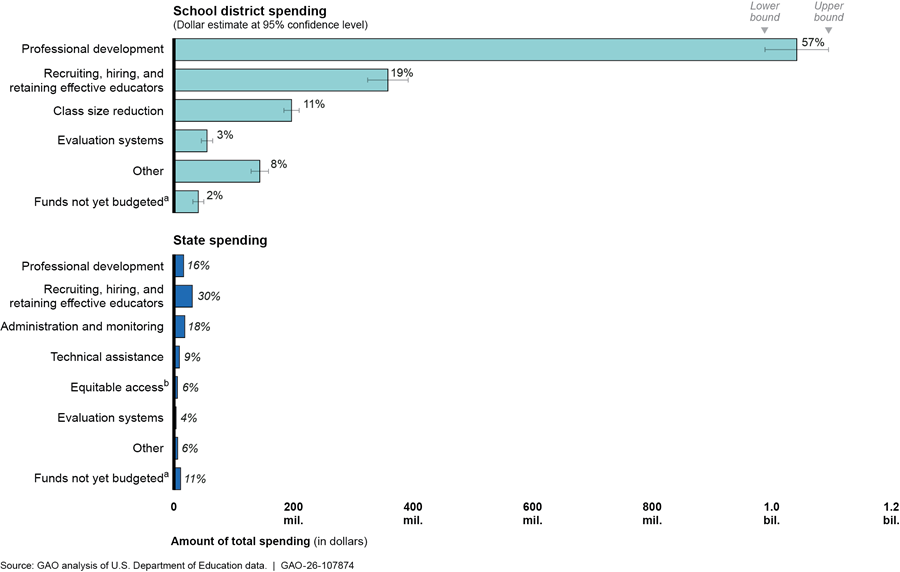
Under Title II‑A, school districts and states may use funds for a broad range of permitted activities related to supporting effective instruction. In school year 2023–24, school districts spent about $1.8 billion, and states spent about $101 million in Title II‑A funds, according to a recent Education report.[10] In school year 2023–24, the amount each state spent ranged from about $262,000 (West Virginia) to about $12 million (California). The estimated average Title II‑A school district allocation was about $125,000 in school year 2023–24, according to the same report. On average, estimated allocations ranged from about $32,000 for small districts to about $1.3 million for large districts.[11] School districts spent an estimated 57 percent of their Title II‑A funds on professional development for teachers, principals, and other school leaders. States spent nearly a third of their Title II‑A funds on recruiting, hiring, and retaining effective educators (see fig. 1).
Figure 1: Title II‑A State Spending and Estimated School District Spending, School Year 2023–24
Notes: Title II‑A refers to Title II, Part A of the Elementary and Secondary Education Act of 1965, as amended. According to Education, state and district spending data come from two sources: a survey of the state educational agencies in all 50 states, the District of Columbia, and Puerto Rico, as well as a district survey that is representative at the state and national levels. Total state and school district spending for school year 2023–24 does not sum to the total allocation to states of $2.2 billion because some allocated funds may not have been spent within the reporting period asked about in the survey, according to Education officials. States and school districts may also have made adjustments and transfers between programs that are not reflected in the spending subtotals. The standard errors for the spending percent estimates are all less than 1 percent. U.S. Department of Education, Office of Elementary and Secondary Education, State and District Use of Title II, Part A Funds in 2023–24 (Jan. 2025).
aFunds not yet budgeted refers to funds reserved for states or school districts that were not budgeted at the time of data collection.
bEquitable access includes activities designed to improve access to effective teachers for low-income and minority students in the state.
Teacher Professional Development Is Associated with Better Student Performance, but Evidence Is Mixed About Which Elements Are Effective
Teacher professional development is generally associated with higher student test scores, according to all five meta-analyses we reviewed.[12] For example, one meta-analysis found teacher professional development was associated with effects on student test scores that were roughly equivalent to one month of additional student progress.[13] Another meta-analysis found that coaching teachers was associated with effects on student test scores that were roughly equivalent to improvements over teachers’ first 5 to 10 years of experience.[14]
The five meta-analyses we reviewed arrived at mixed conclusions about which individual elements of teacher professional development were positively associated with effect sizes on student test scores.[15] Below, we present findings on elements that appeared in at least three of the five meta-analyses.[16] See appendix III for additional details and findings from the meta-analyses.
Alignment with curriculum. Three of the four meta-analyses that reviewed alignment with curriculum did not find associations with effect sizes on student test scores.[17] The fourth meta-analysis found mixed results.[18] Specifically, this meta-analysis found a positive association between professional development focused on how to use curriculum materials and effect sizes. The same meta-analysis found no association between professional development in which teachers developed curricula or lesson plans and effect sizes.
Coaching. Two of the three meta-analyses that reviewed coaching did not find associations between coaching and effect sizes on student test scores.[19] The third meta-analysis found that coaching is generally associated with higher student test scores.[20]
Collaboration. Two of the three meta-analyses that reviewed collaboration in teacher professional development found generally positive associations with effect sizes on student test scores.[21] For example, one meta-analysis found a positive association between professional development that included meetings between teacher participants and effect sizes.[22] The third meta-analysis did not find an association between collaboration and effect sizes.[23]
Duration. None of the four meta-analyses that reviewed the duration of professional development found an association between the length of the professional development and effect sizes on student test scores.[24]
Focus on subject matter. Two of the three meta-analyses that reviewed professional development’s focus on subject matter did not find associations with effect sizes on student test scores.[25] The third found a positive association between professional development’s focus on subject matter and effect sizes.[26] Specifically, this meta-analysis found that focusing on pedagogical content knowledge (e.g., how students learn science) was positively associated with effect sizes.
Provider type. None of the three meta-analyses that reviewed the type of professional development provider found associations between the kind of facilitator (e.g., researchers, district staff, or independent facilitators) and effect sizes on student test scores.[27]
We also reviewed five U.S. Department of Education randomized controlled trials of teacher professional development programs.[28] These programs included almost all selected requirements for professional development under the ESEA and a list of “core features” recommended in seminal 2009 research (see table 1).[29] All five studies compared the specific professional development programs they examined to the professional development practices teachers would have otherwise received. Of the five studies, three found no effects on student test scores, one found a delayed effect but only for professional development that lasted at least 2 years, and one found positive effects but was less generalizable than the other studies we reviewed.[30] For example, one of the studies that found no effects examined a teacher professional development program with a subject-matter focus on mathematics.[31]
| Citation | Elements included | Effects on student test scores |
| Michael S. Garet et al., Focusing on Mathematical Knowledge: The Impact of Content-Intensive Teacher Professional Development, National Center for Education Evaluation and Regional Assistance Report No. 2016-4010, Institute of Education Sciences, U.S. Department of Education (2016). | þ Includes all selected requirements for professional development under the ESEAaþ Includes all elements from the “core features” frameworkb | None |
| Yasuyo Abe, Vanora Thomas, Castle Sinicrope, and Kevin A. Gee, Effects of the Pacific Child Professional Development Program, National Center for Education Evaluation and Regional Assistance Report No. 2013-4002, Institute of Education Sciences, U.S. Department of Education (2012). | þ Includes all selected requirements for professional development under the ESEAaþ Includes all elements from the “core features” frameworkb | Increased student test scores in reading comprehension.** |
| Michael S. Garet et al., Middle School Mathematics Professional Development Impact Study: Findings After the Second Year of Implementation, National Center for Education Evaluation and Regional Assistance Report No. 2011-4024, Institute of Education Sciences, U.S. Department of Education (2011). | þ Includes all selected requirements for professional development under the ESEAaþ Includes all elements from the “core features” frameworkb | None |
| Steven Glazerman et al., Impacts of Comprehensive Teacher Induction: Final Results from a Randomized Controlled Study, National Center for Education Evaluation and Regional Assistance Report No. 2010-4027, Institute of Education Sciences, U.S. Department of Education (2010). | þ Includes all selected requirements for professional development under the ESEAaþ Includes all elements from the “core features” frameworkb except for focus on subject matter | None for schools receiving 1 year of comprehensive induction or for schools receiving 2 years of comprehensive induction in the first 2 years of the program.For schools receiving 2 years of comprehensive induction, positive effect on student math*** and reading** test scores in the third year after the program. |
| Michael S. Garet et al., The Impact of Two Professional Development Interventions on Early Reading Instruction and Achievement, National Center for Education Evaluation and Regional Assistance Report No. 2008-4030, Institute of Education Sciences, U.S. Department of Education (2008). | þ Includes all selected requirements for professional development under the ESEAaþ Includes all elements from the “core features” frameworkb | None |
** = statistically significant at the 0.05 significance level *** = statistically significant at the 0.01 significance level
Source: GAO analysis of selected Education studies. ꞁ GAO‑26‑107874
aProfessional development program(s) includes selected requirements for professional development under the Elementary and Secondary Education Act of 1965, as amended (ESEA). That is, professional development program(s) is sustained (i.e., not stand-alone, one-day, or short-term workshops), intensive, collaborative, job-embedded, data-driven, and classroom-focused. These terms have not been further defined in regulations or guidance, according to Education officials.
bProfessional development program(s) includes all elements from the “core features” framework. That is, professional development program(s) includes sufficient duration, collective participation (i.e., collaboration), content focus (i.e., focus on subject matter), active learning, and coherence. Laura M. Desimone, “Improving Impact Studies of Teachers’ Professional Development: Toward Better Conceptualizations and Measures,” Educational Researcher, vol. 38, no. 3 (2009).
Nationally, Teachers Identified Collaborative Learning as the Most Useful Element of Professional Development
Nationwide, most teachers said collaborative learning opportunities with other teachers improved their teaching or their students’ learning, according to a nationally representative RAND survey of K-12 public school teachers for school year 2022–23.[32] RAND estimated about 67 percent of teachers said collaborative learning improved their teaching or student learning to a moderate or large extent, compared to about 43 percent for workshops (i.e., trainings) and about 44 percent for coaching (see fig. 2).[33] Teachers reported mostly spending collaborative learning time on sharing instructional strategies, studying upcoming lessons, adapting materials to meet students’ needs, addressing student behavioral issues, reviewing student work, and reviewing student assessment data, according to RAND’s updated survey for school year 2023–24.[34]
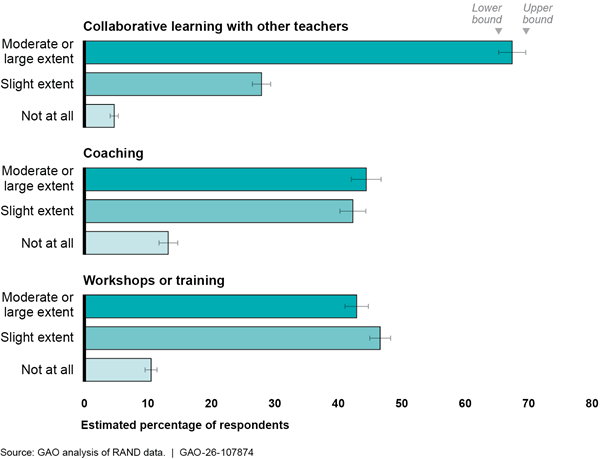
Notes: The brackets represent 95 percent confidence intervals; all nonoverlapping intervals are statistically different. According to RAND, results are nationally representative of teachers but may not represent new schools, new teachers, or experienced teachers new to a school district. RAND defines “collaborative learning with other teachers” as opportunities for teachers to work with teams of other teachers grouped by content area or grade level to address shared problems of practice; “coaching” as opportunities teachers have to be observed by experts and provided feedback; and “workshops or trainings” as learning experiences, typically offered by third-party providers outside the classroom, to teach educators about specific resources, materials, or instructional strategies. According to RAND, respondents were not provided with comprehensive definitions for each element of professional development and may have interpreted the terms inconsistently.
Similarly, teachers who responded to our nongeneralizable questionnaire said collaborative professional development was useful for their classroom teaching. For example, respondents said professional learning communities helped them share resources, exchange ideas, or reflect on teaching practices or issues in the classroom.[35] Other useful elements that respondents most commonly identified included teaching and learning strategies, content relevant to the subject or grade level they taught, and management of student behaviors (see text box).
Elements of Professional Development that Selected Teachers Found Useful
“The most useful professional development for me has been collaborative learning with colleagues, job-embedded coaching, and hands-on workshops focused on specific instructional strategies. These formats allowed me to immediately apply what I learned, receive feedback, and adapt practices to fit my students’ needs. [Professional development] that is practical, ongoing, and connected to real classroom challenges has had the greatest impact on my teaching. In contrast, one-size-fits-all or theory-heavy sessions without classroom application have been less effective.”
“[Professional development] sessions that allowed me to engage in the same activities I would later implement with students were incredibly valuable. For example, a literacy workshop that modeled differentiated reading strategies helped me immediately apply those methods in small reading groups.”
“Some professional development has helped me shift how I run my classroom. I think the most beneficial things that I have taken from [professional development] are about routines and procedures, and how to run your classroom better. Having a better understanding and seeing other ways to do this really has helped my class. I can spend less time on the small stuff and focus more on the content.”
Source: GAO teacher questionnaire. | GAO‑26‑107874
Elements of Professional Development that Selected Teachers Did Not Find Useful
As for the elements of professional development teachers did not find useful for classroom teaching, questionnaire respondents most commonly identified professional development that was not relevant to their subject or grade level, or trainings that were only offered one time without follow-up (see text box). For example, one teacher said professional development sessions that did not provide enough time for teachers to practice implementation or interact with other teachers were not helpful. The same teacher said professional development was often advertised as applicable to all teachers, but in fact was only relevant to teachers in certain subject matter areas.
“Workshops and trainings that everyone in a building is required to go to are not useful because they often are best for a particular grade level or subject and not applicable to everyone. Mini sessions that only last 20–30 [minutes in] length are not long enough to learn something new and how to apply it.”
“I’ve attended very little [professional development] at the depth that it needs to be to actually develop teachers to the level we would all like to be. Schools and school districts try to cram things into a 45–50 minute planning time (when we really need to use the bathroom, make sure our materials are prepped for the rest of the day, and breathe) or they try and shove something that should be 3 hours into an hour faculty meeting on Monday afternoon[,] then give us no follow-up time to plan or implement what the [professional development] was about. Therefore, we mostly get surface level items.”
Source: GAO teacher questionnaire. | GAO‑26‑107874
Officials from Selected States and School Districts Generally Said They Valued Title II‑A’s Flexibility and Straightforward Requirements to Help Meet Local Needs
Officials from all three selected states and all nine school districts we interviewed described using Title II‑A flexibility to meet the educational needs of their communities. Title II‑A allows states and school districts to use funds on a variety of activities, such as professional development, teacher recruitment and retention, or hiring additional educators to reduce class sizes.[36] District officials said they generally decided how to spend their Title II‑A allocations based on factors such as local needs, community input, school- or school district-level data, as well as state or federal guidance.
State perspectives. State officials in New Mexico, Pennsylvania, and Tennessee described using Title II‑A’s flexibility to advance statewide education goals. For example, New Mexico officials described using Title II‑A funds to train school district officials on mentoring and recruitment, build a statewide cadre of mentors, and train teachers for leadership and administrative positions. Tennessee officials described using state-level Title II‑A funding for professional development for principals. These efforts align with one of the state’s ESEA priorities to support the preparation and development of an exceptional educator workforce, according to our analysis of Tennessee’s ESEA consolidated state plan.
Officials from all three states also found aspects of Title II‑A’s requirements helpful or easy to implement. For example, officials from Pennsylvania and New Mexico found it helpful that Title II‑A professional development is required to be sustained (not stand-alone, one-day or short-term workshops). Officials in New Mexico noted that Title II‑A requirements helped the state guide school districts to use Title II‑A funds on efforts that are more effective at supporting improvements in student outcomes. Regarding issues with administering Title II‑A funds, we analyzed Education’s fiscal years 2019–2024 consolidated performance review reports of 18 states and found that the most common Title II‑A issue was ensuring that school districts only used Title II‑A funds for professional development activities that met the statutory definition.[37]
| Ensuring Compliance with Title II‑A Requirements, According to Selected State OfficialsOfficials from the three selected states reported taking a variety of approaches to ensuring school districts complied with Title II, Part A (Title II‑A) requirements. For example, in Pennsylvania, the state monitored school districts and updated its district application for Title II‑A funds by adding legal assurances and narrative explanations. Officials from New Mexico said the state provided liaisons to directly answer questions from a group of school districts. The state also provided trainings to school districts to help them understand allowable uses of Title II‑A funds.Officials from two of the three selected states shared various ways they helped school districts meet the evidence-based professional development requirements for Title II‑A funding. For example, officials from these states reported providing resources to help school districts find or use evidence-based professional development. Officials from one state reported ensuring that school districts met Title II‑A’s evidence-based requirements by integrating them into the districts’ application process for Title II‑A funds. Source: GAO interviews with state educational agency officials. | GAO‑26‑107874 |
School district perspectives. All nine selected school districts, from urban, suburban, and rural or town locations across our three states, described leveraging the flexibility of Title II‑A funds to address needs, such as teacher retention. For example, officials from one urban school district said the district leveraged its Title II‑A funds to support a principal residency program. A suburban school district official said they identified a need for additional professional development funding for specific content areas and used Title II‑A funds for stipends that brought content area experts into the classroom. Officials from two school districts described using Title II‑A funding flexibility to support class size reductions and noted that Title II‑A’s requirements for professional development were burdensome. An official from one of these districts said they preferred to use local funds for professional development because there were no requirements tied to those funds.
Rural areas especially face challenges with teacher recruitment and retention.[38] Officials from all three rural or town school districts we met with said they strategically allocated their Title II‑A funding to address their unique challenges. For example, an official from one rural school district said that their district already had private funding available for professional development so that enabled them to use Title II‑A funds for teacher stipends. By increasing teachers’ pay, the school district was able to compete with a neighboring school district that offered higher wages. An official in another rural school district said they felt isolated as a rural community, and that their previous use of Title II‑A funds on conferences was not as effective as they had hoped. This official said they switched gears and used their Title II‑A funds to partner with an organization that helped them incorporate best practices into their professional development, yielding better results.
Officials from six of the nine selected school districts also said that Title II‑A requirements help to ensure that professional development is high quality or effective. For example, one school district official shared that the Title II‑A evidence-based requirements help the school district maintain an expectation of high-quality professional development with its schools, which was important given how much districts can spend on professional development.[39] Another school district official noted that Title II‑A’s stakeholder consultation requirements help the district engage community members, parents, and others about Title II‑A’s uses and impacts. Officials from all nine school districts said Title II‑A requirements were straightforward to implement or easier to implement than other programs.
We also asked school district officials if they faced challenges implementing the requirements of Title II‑A funds. In three of the nine school districts, officials identified challenges with restrictions on using Title II‑A funds for professional development of district staff who are not school based. For example, one school district official said the district could not pay for district staff’s professional development with Title II‑A funds even though there were some staff, such as special education leads, who also needed it.
GAO Contact and Staff Acknowledgments
GAO Contact
Jacqueline M. Nowicki, NowickiJ@gao.gov
Staff Acknowledgments
In addition to the contact named above, Scott Spicer (Assistant Director), Maria Gadel (Analyst in Charge), Liz Spurgeon (Analyst in Charge), Walker Adams, and Matthew Naven made key contributions to this report. Also contributing to this report were James Bennett, Elizabeth Calderon, Craig Comen, Kristy Kennedy, Rebecca Sero, Lindsay Shapray, Margaret Sommerfeld, Sonya Vartivarian, and Erin Villareal.
GAO’s Mission
The Government Accountability Office, the audit, evaluation, and investigative arm of Congress, exists to support Congress in meeting its constitutional responsibilities and to help improve the performance and accountability of the federal government for the American people. GAO examines the use of public funds; evaluates federal programs and policies; and provides analyses, recommendations, and other assistance to help Congress make informed oversight, policy, and funding decisions. GAO’s commitment to good government is reflected in its core values of accountability, integrity, and reliability.
Obtaining Copies of GAO Reports and Testimony
The fastest and easiest way to obtain copies of GAO documents at no cost is through our website. Each weekday afternoon, GAO posts on its website newly released reports, testimony, and correspondence. You can also subscribe to GAO’s email updates to receive notification of newly posted products.
Order by Phone
The price of each GAO publication reflects GAO’s actual cost of production and distribution and depends on the number of pages in the publication and whether the publication is printed in color or black and white. Pricing and ordering information is posted on GAO’s website, https://www.gao.gov/ordering.htm.
Place orders by calling (202) 512-6000, toll free (866) 801-7077, or
TDD (202) 512-2537.
Orders may be paid for using American Express, Discover Card, MasterCard, Visa, check, or money order. Call for additional information.
Connect with GAO
Connect with GAO on X, LinkedIn, Instagram, and YouTube.
Subscribe to our Email Updates. Listen to our Podcasts.
Visit GAO on the web at https://www.gao.gov.
To Report Fraud, Waste, and Abuse in Federal Programs
Contact FraudNet:
Website: https://www.gao.gov/about/what-gao-does/fraudnet
Automated answering system: (800) 424-5454
Media Relations
Sarah Kaczmarek, Managing Director, Media@gao.gov
Congressional Relations
David A. Powner, Acting Managing Director, CongRel@gao.gov
General Inquiries
https://www.gao.gov/about/contact-us
[1]Under the Elementary and Secondary Education Act of 1965, as amended (ESEA), the term “evidence-based” generally means that an activity, strategy, or intervention demonstrates a statistically significant effect on improving student outcomes or other relevant outcomes based on certain evidence, or that it (I) demonstrates a rationale based on high-quality research findings or positive evaluation that such activity, strategy, or intervention is likely to improve student outcomes or other relevant outcomes; and (II) includes ongoing efforts to examine the effects of such activity, strategy, or intervention. 20 U.S.C. § 7801(21).
[2]Professional development under the ESEA is defined at 20 U.S.C. § 7801(42).
[3]We focused our review on how teacher professional development improves student test scores because ESEA focuses on improving student outcomes in its definition of evidence-based, and because all five meta-analyses we reviewed measured student outcomes using test scores.
[4]U.S. Department of Education, Office of Elementary and Secondary Education, State and District Use of Title II, Part A Funds in 2023–24 (Jan. 2025).
[5]For the purposes of this report, we refer to state educational agencies as states, and we refer to local educational agencies as school districts.
[6]U.S. Department of Education, State and District Use of Title II, Part A Funds in 2023–24. According to Education officials, as of June 2025, the contract for this report series had been canceled.
[7]Specifically, after making certain reservations, Education calculates Title II-A allocations to states as follows: 20 percent based on each state’s number of children ages 5-17 compared to this population in all States; and 80 percent based on each State’s number of individuals ages 5-17 from families with incomes below the poverty line compared to this population in all states.
[8]For example, see U.S. Department of Education, State and District Use of Title II, Part A Funds in 2023–24.
[9]Of these funds, states may reserve up to an additional 3 percent for a range of state-level activities aimed at improving the effectiveness of principals and other school leaders.
[10]For school year 2023–24, the total amount available for Title II-A state-level activities was about $102.6 million, and for districts the total amount allocated was about $2.1 billion. Some allocated funds may not have been spent within the reporting period asked about in the survey, according to Education officials. States and school districts may have also made adjustments and transfers between programs that are not reflected in the spending subtotals. U.S. Department of Education, State and District Use of Title II, Part A Funds in 2023–24.
[11]Large school districts enroll more than 10,000 students, medium districts enroll from 2,500 to 10,000 students, and small districts enroll fewer than 2,500 students. U.S. Department of Education, State and District Use of Title II, Part A Funds in 2023–24.
[12]In all five meta-analyses, the average of the estimates for the overall association between teacher professional development and student test scores was positive and significant at the 0.01 significance level. All five meta-analyses we reviewed compared the specific professional development programs in the studies they examined to the professional development teachers would have otherwise received. Two meta-analyses also compared these specific programs to control groups that received alternative professional development programs. Two meta-analyses also compared these specific programs to control groups that received no professional development. Matthew Kraft, David Blazar, and Dylan Hogan, “The Effect of Teacher Coaching on Instruction and Achievement: A Meta-Analysis of the Causal Evidence,” Review of Educational Research, vol. 88, no. 4 (2018); Kathleen Lynch, Heather C. Hill, Kathryn Gonzalez, and Cynthia Pollard, “Strengthening the Research Base That Informs STEM Instructional Improvement Efforts: A Meta-Analysis,” Educational Evaluation and Policy Analysis, vol. 41, no. 3 (2019); Marianne Rice, Kacee Lambright, and Kausalai (Kay) Wijekumar, “Professional Development in Reading Comprehension: A Meta-Analysis of the Effects on Teachers and Students,” Reading Research Quarterly, vol. 59, no. 3 (2024); Sam Sims et al., “What Are the Characteristics of Effective Teacher Professional Development? A Systematic Review and Meta-Analysis,” Education Endowment Foundation (2021), ERIC no. ED615914; Adrie J. Visscher, Natasha Dmoshinskaia, Marta Pellegrini, and Anny Rey-Naizaque, “(When) Do Teacher Professional Development Interventions Improve Student Achievement? A Meta-Analysis of 128 High-Quality Studies,” Educational Research Review, vol. 49 (2025).
[13]Sims et al., “Characteristics of Effective Teacher Professional Development.”
[14]Kraft, Blazar, and Hogan, “Effect of Teacher Coaching on Instruction and Achievement.”
[15]The effect size is defined as the estimated effect of a teacher professional development program on student test scores, relative to the professional development practices teachers would have otherwise received, alternative professional development programs, or no teacher professional development.
[16]For our analysis, we defined “alignment with curriculum” as support for teachers’ implementation and use of instructional materials and coordination of professional development with curriculum content and instructional strategies; “coaching” as opportunities teachers have to be observed by experts and provided feedback; “collaboration” as opportunities for teachers to work together in groups or teams; “duration” as the number of hours of professional development provided to teachers; “focus on subject matter” as relevance to academic content and how students learn that content, and “provider type” as the category of facilitator who provided the professional development to teachers (e.g., researchers, district staff, or independent facilitators).
[17]Kraft, Blazar, and Hogan, “Effect of Teacher Coaching on Instruction and Achievement”; Visscher, Dmoshinskaia, Pellegrini, and Rey-Naizaque, “Teacher Professional Development Interventions”; Rice, Lambright, and Wijekumar, “Professional Development in Reading Comprehension.”
[18]Lynch, Hill, Gonzalez, and Pollard, “STEM Instructional Improvement Efforts.”
[19]Lynch, Hill, Gonzalez, and Pollard, “STEM Instructional Improvement Efforts”; Rice, Lambright, and Wijekumar, “Professional Development in Reading Comprehension.”
[20]Kraft, Blazar, and Hogan, “Effect of Teacher Coaching on Instruction and Achievement.”
[21]Kraft, Blazar, and Hogan, “Effect of Teacher Coaching on Instruction and Achievement”; Lynch, Hill, Gonzalez, and Pollard, “STEM Instructional Improvement Efforts.”
[22] Lynch, Hill, Gonzalez, and Pollard, “STEM Instructional Improvement Efforts.”
[23]Rice, Lambright, and Wijekumar, “Professional Development in Reading Comprehension.”
[24]We cannot infer anything about the relationship between duration and effect size for durations shorter than the minimum duration included in each meta-analysis. For example, one meta-analysis did not include studies of professional development programs that lasted less than 12 weeks, and another did not include studies of professional development programs that lasted less than 3 hours. Kraft, Blazar, and Hogan, “Effect of Teacher Coaching on Instruction and Achievement”; Lynch, Hill, Gonzalez, and Pollard, “STEM Instructional Improvement Efforts”; Rice, Lambright, and Wijekumar, “Professional Development in Reading Comprehension”; Visscher, Dmoshinskaia, Pellegrini, and Rey-Naizaque, “Teacher Professional Development Interventions.”
[25]Kraft, Blazar, and Hogan, “Effect of Teacher Coaching on Instruction and Achievement”; Visscher, Dmoshinskaia, Pellegrini, and Rey-Naizaque, “Teacher Professional Development Interventions.”
[26]Lynch, Hill, Gonzalez, and Pollard, “STEM Instructional Improvement Efforts.”
[27]Lynch, Hill, Gonzalez, and Pollard, “STEM Instructional Improvement Efforts”; Rice, Lambright, and Wijekumar, “Professional Development in Reading Comprehension”; Visscher, Dmoshinskaia, Pellegrini, and Rey-Naizaque, “Teacher Professional Development Interventions.”
[28]Randomized controlled trials are generally considered the “gold standard” for evaluating the causal effects of interventions such as teacher professional development programs. However, to the extent that schools in the randomized controlled trials have different characteristics than the national average, results from the studies may not generalize to the United States.
[29]In 2009, a study proposed a consensus had emerged around a set of five “core features” (i.e., elements) for effective teacher professional development. The features include sufficient duration, collective participation (i.e., collaboration), content focus (i.e., focus on subject matter), active learning, and coherence. While researchers have proposed other lists of effective elements of professional development, all five meta-analyses we reviewed referred to this framework as influential or as part of a consensus or list of best practices. Laura Desimone, “Improving Impact Studies of Teachers’ Professional Development: Toward Better Conceptualizations and Measures,” Educational Researcher, vol. 38, no. 3 (2009).
[30]The study with a delayed effect found an effect in the third year in schools that received at least 2 years of a professional development program. The study found no effects in schools receiving 1 year of the program and no effects during the first 2 years in schools receiving 2 years of the program. Steven Glazerman et al., Impacts of Comprehensive Teacher Induction: Final Results from a Randomized Controlled Study, National Center for Education Evaluation and Regional Assistance Report No. 2010-4027, Institute of Education Sciences, U.S. Department of Education (2010). The study with positive effects used a convenience sample of schools in Hawai’i, American Samoa, and the Commonwealth of the Northern Mariana Islands. Furthermore, the study found the program increased English reading comprehension scores, and American Samoa and the Commonwealth of the Northern Mariana Islands generally have more English language learners than the U.S. average. Yasuyo Abe, Vanora Thomas, Castle Sinicrope, and Kevin A. Gee, Effects of the Pacific CHILD Professional Development Program, National Center for Education Evaluation and Regional Assistance Report No. 2013-4002, Institute of Education Sciences, U.S. Department of Education (2012).
[31]Michael S. Garet et al., Focusing on Mathematical Knowledge: The Impact of Content-Intensive Teacher Professional Development, National Center for Education Evaluation and Regional Assistance Report No. 2016-4010, Institute of Education Sciences, U.S. Department of Education (2016).
[32]RAND’s American Instructional Resources Survey received over 8,500 responses from teachers in the 2022–23 school year. According to RAND, results are nationally representative of teachers but may not represent new schools, new teachers, or experienced teachers new to a school district. RAND updated the survey for school year 2023–24 but did not ask this specific question in the updated survey. Sy Doan, Joshua Eagan, David Grant, and Julia H. Kaufman, American Instructional Resources Surveys: 2023 Technical Documentation and Survey Results(Santa Monica, CA: RAND Corporation, 2023).
[33]RAND defines collaborative learning with other teachers as “opportunities, such as instructional planning time or professional learning communities, for teachers to work with teams of other teachers grouped by content area or grade level to address shared problems of practice;” coaching as “opportunities teachers have to be observed by experts (for example, master teachers, department leads, school administrators) and provided feedback on the basis of the observed lessons;” and workshops or trainings as “learning experiences, typically offered by third-party providers outside the classroom, to teach educators about specific resources, materials, or instructional strategies.” According to RAND, respondents were not provided with comprehensive definitions for each element of professional development and may not have interpreted the terms the same way.
[34]Sy Doan, Joshua Eagan, David Grant, and Julia H. Kaufman, American Instructional Resources Surveys: 2024 Technical Documentation and Survey Results (Santa Monica, CA: RAND Corporation, 2024).
[35]Professional learning communities are a collaborative form of professional development in which small groups of educators with shared interests work together with the goals of expanding their knowledge and improving their craft, according to Education. Typically, a professional learning community consists of a team of teachers that meets regularly to learn new topics, share ideas, and problem solve.
[36]For the allowable use of funds under Title II-A for states and school districts, see 20 U.S.C. §§ 6311(c) and 6613, respectively.
[37]The definition of professional development changed with the reauthorization of ESEA in 2015. States had through the 2017–18 school year to implement the reauthorization’s core components, according to Education.
[38]GAO‑ K‑12 Education: Education Should Assess Its Efforts to Address Teacher Shortages, GAO‑23‑105180 (Washington, D.C.: Oct. 27, 2022).
[39]The evidence-based requirements apply to certain professional development activities funded under Title II-A.
[40]U.S. Department of Education, Office of Elementary and Secondary Education, State and District Use of Title II, Part A Funds in 2023–24 (Jan. 2025).
[41]Meta-analysis is a statistical method for combining the results of multiple individual studies. We focused our review on how teacher professional development improves student test scores because ESEA focuses on improving student outcomes in its definition of evidence-based, and because all five meta-analyses we reviewed measured student outcomes using test scores.
[42]A systematic review attempts to answer a specific research question by identifying, appraising, and synthesizing all the empirical evidence—such as published and unpublished studies by other researchers—that meets pre-specified eligibility criteria. Researchers conducting these reviews use explicit, systematic methods that aim to minimize bias and produce more reliable findings than individual studies.
[43]Sam Sims, et al., “What Are the Characteristics of Effective Teacher Professional Development? A Systematic Review and Meta-Analysis,” Education Endowment Foundation (2021), ERIC No. ED615914.
[44]Adrie J. Visscher, Natasha Dmoshinskaia, Marta Pellegrini, and Anny Rey-Naizaque, “(When) Do Teacher Professional Development Interventions Improve Student Achievement? A Meta-Analysis of 128 High-Quality Studies,” Educational Research Review, vol. 49 (2025).
[45]Kathleen Lynch, Heather C. Hill, Kathryn Gonzalez, and Cynthia Pollard, “Strengthening the Research Base That Informs STEM Instructional Improvement Efforts: A Meta-Analysis,” Educational Evaluation and Policy Analysis, vol. 41, no. 3 (2019).
[46]Sy Doan, Joshua Eagan, David Grant, and Julia H. Kaufman, American Instructional Resources Surveys: 2023 Technical Documentation and Survey Results (Santa Monica, CA: RAND Corporation, 2023); Sy Doan, Joshua Eagan, David Grant, and Julia H. Kaufman, American Instructional Resources Surveys: 2024 Technical Documentation and Survey Results (Santa Monica, CA: RAND Corporation, 2024).
Leave a Reply