



The Complexities of Collaborative Coaching in Schools Under Pressure to Improve.
Weddle, H., Lockton, M., & Datlow, A. (2023). Sage Publishing. https://files.eric.ed.gov/fulltext/EJ1399295.pdf
Abstract
Recent research has examined the influential role coaches may play in supporting teachers’ collective capacity building for instructional improvement. While emerging research is promising, much remains to be learned about collaborative approaches to coaching, particularly in schools with the greatest opportunity gaps. We draw on extensive longitudinal qualitative data to explore a collaborative approach to coaching in urban middle schools under pressure to improve math outcomes. Findings reveal key coaching strategies to promote teacher team capacity building, including fostering student-centered discussion and collaborative relationships, tailoring capacity-building opportunities to provide access for all teachers, and negotiating across teachers and leaders to support improvement efforts. This work was complicated by conflicting expectations between leaders and teachers as well as challenges with addressing teachers’ misconceptions about math content in group settings. These findings reflect the need for ongoing capacity building that supports coaches as they attend to group dynamics and accountability pressures.
Keywords: accountability; case studies; collaboration; educational reform; in-depth interviewing; observational research; qualitative research
Introduction
Amid widespread efforts to accelerate student learning, many schools and districts are focused on building teachers’ capacity to improve instruction, particularly in core subjects such as mathematics. School leaders and policymakers have long placed teacher collaboration at the center of such reform efforts to improve instruction (Datnow & Park, 2018; Stoll et al., 2006; Vangrieken et al., 2015). However, the depth of teachers’ opportunities to learn through collaboration is mediated by the expertise available within the group (Horn & Kane, 2015; Lockton, 2019). While studies demonstrate how coaches can serve as sources of expertise supporting teacher capacity building (Booker & Russell, 2022; Darling-Hammond et al., 2009; Gibbons & Cobb, 2016; Hanno, 2022; Matsumura et al., 2009), such research has traditionally focused on coaching with individual teachers (Mangin & Dunsmore, 2015). More recently, some scholars have documented coaches’ approaches to leading activities with groups of teachers (Gibbons & Cobb, 2017; Hopkins et al., 2018; Woulfin & Jones, 2018) and facilitating teachers’ collaborative interactions (Spillane et al., 2015).
While emerging research on collaborative approaches to coaching is promising, few studies are situated in schools under significant pressure to improve student achievement. Such schools are especially important to consider given persistent opportunity gaps across race and socioeconomic status in K–12 education (Hemphill & Vanneman, 2011; Ladson-Billings, 2006; Reardon, 2013; Sirin, 2005; Vanneman et al., 2009). A deeper understanding of collaborative coaching in these contexts may provide actionable insights to inform instructional improvement efforts. Focusing on math teacher teams in four racially and socioeconomically diverse urban middle schools, we draw on extensive qualitative data collected over four years to explore: What strategies support a collaborative approach to coaching in urban schools under significant pressure to improve? What challenges mediate collaborative coaching?
In this study, we draw on extensive longitudinal qualitative data collected between 2015–2019 to reveal the complexities of coaching for collective capacity building amid high-stakes accountability pressures. Findings illustrate how the coach helped to foster teacher teams’ discussions about student thinking and increase collaborative planning and reflection. While such out-comes are promising, the coach also navigated challenges associated with addressing teachers’ misconceptions about math content in group settings. Much of her work involved tailoring her approach to align with teachers’ needs and goals and negotiating across varied expectations between administrators and teacher teams. These findings reveal specific collaborative coaching strategies that helped to promote improvement and also shed light on the need for ongoing capacity building that supports coaches with attending to complex group dynamics and accountability pressures. Such insights are especially timely given the role coaching may play as a strategy to improve instruction and accelerate student learning (Blazar, 2020; Booker & Russell, 2022) and the proliferation of investments in coaching across states, districts, and schools (Woulfin et al., 2023).
Literature Review
For several decades, content-focused coaching has represented a pervasive strategy for promoting teacher professional learning (Coburn & Russell, 2008; Connor, 2017; Darling-Hammond et al., 2009; Gibbons & Cobb, 2016; Woulfin & Rigby, 2017; Woulfin et al., 2023). Coaching is seen as a promising capacity-building approach since it embodies five key features of effective professional learning including active learning, a content focus, sustained duration, coherence, and collective participation (Desimone & Pak, 2017). Prior research reveals coaches can increase teachers’ access to content area expertise (Hopkins et al., 2013), challenge deficit frameworks (Gibbons et al., 2017), facilitate data use (Huguet et al., 2014), promote student achievement (Campbell & Malkus, 2011), and support teachers’ abilities to address instructional goals (Gardiner, 2012). In many districts, coaches are also part of the infrastructure for reform (Huguet et al., 2014; Woulfin & Jones, 2018), playing an important role in framing policy messages for teachers (Woulfin & Jones, 2018).
Coaching practice is highly contextualized, with different combinations of factors shaping coaches’ effectiveness across districts and schools. For example, sufficient time to meet and collaborate with teachers, as well as the presence of support from school leadership, can influence the coaching process (Gibbons & Cobb, 2016; Matsumura et al., 2009). Structures and policies established by district leaders also impact coaches’ ability to devote time to instructional improvement and the alignment of coaching with district priorities (Woulfin et al., 2023). In Hashim’s (2020) study, top-down hierarchies and organizational silos within the district influenced how coaches brokered information to teachers. Coaches must also navigate school and district-level power hierarchies, which tend to be heightened in schools that are underperforming and facing accountability concerns (Finnigan & Daly, 2012).
Complementing the literature on coaching, a robust body of scholarship outlines the benefits of teachers’ engagement in collaboration (Datnow & Park, 2018; Stoll et al., 2006; Vangrieken et al., 2015). These benefits include the development of supportive relationships and increased understanding of content and pedagogical approaches (Vangrieken et al., 2015). Studies also demonstrate a positive relationship between teachers’ engagement in collaboration and student achievement (Ronfeldt et al., 2015; Vescio et al., 2008). Importantly, teachers’ opportunities to learn and improve through collaboration are shaped by the availability of expertise within the team (Horn & Kane, 2015; Lockton, 2019; Weddle, 2020).
As with coaching, collaboration is also contextual. A teacher team’s understanding of policy messages and administrator expectations for their instruction as well as their collaboration, and their perception of the coherence and priority of these, shape the way they spend their time and even the degree to which they collaborate (Coburn & Russell, 2008; Vangrieken et al., 2015). Characteristics of team members such as their level of content expertise (Horn & Kane, 2015) and capacity of collaborative inquiry and reflection support or constrain their work, as do asset/deficit frameworks and norms and relationships among teachers (Louie, 2016; Sutton & Shouse, 2018).
Recognizing the potential benefits of layering coaching onto collaboration to support teachers’ collective capacity building, an emerging body of work examines coaches’ work with teams of teachers (e.g., Gibbons & Cobb, 2017; Hopkins et al., 2018; Spillane et al. 2015). These studies document coaches’ successful efforts to lead capacity-building activities with groups of teachers (Gibbons & Cobb, 2017) and facilitate teachers’ collaborative interactions (Spillane et al., 2015). Research also reveals how collaborative approaches to coaching can contribute to changes in teachers’ classroom practices (Hopkins et al., 2018). While such research is promising, less is known about the challenges coaches face when supporting teams of teachers in high accountability contexts or strategies to effectively navigate these challenges over time.
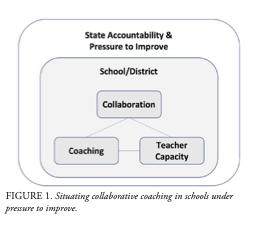
Grounded in prior literature, Figure 1 outlines our conceptualization of the relationship between coaching, teacher capacity, and collaboration. Nested in school, district, and state contexts, a collaborative approach to coaching reflects a promising pathway for supporting teacher capacity building. To better understand how coaches can bridge collaboration and capacity building—particularly in schools with the greatest opportunity gaps, we draw on extensive qualitative data collected in urban schools under pressure to improve.
Findings
Our analysis revealed several benefits and challenges of a collaborative approach to coaching in urban schools under pressure to improve. Specifically, findings reveal three strategies the coach employed to promote team capacity building: fostering student-centered discussion and collaborative relationships, tailoring capacity building opportunities to provide access for all teachers, and negotiating across teachers and leaders to support improvement efforts. While these efforts reflect the potential benefits of collaborative coaching, the coach also faced challenges with addressing teachers’ misconceptions about math content in group settings. Further, her work was complicated by persistent accountability pressures that shaped varied expectations between teachers and administrators. We expand on these themes in the following sections, highlighting how the coach worked to bridge teacher capacity building and collaboration in schools facing significant accountability pressures.
Fostering Conversations About Student Thinking
Across the four years studied, we observed a shift in teachers’ conversations about instruction taking place during collaboration meetings. During the first year of the project, teachers’ lesson-planning discussions were infrequent. When they did occur, such conversations rarely referenced student thinking or understanding. Instead, these early conversations tended to focus on the logistics of what to teach and when. Recognizing the potential for more student-centered discussions, the coach focused her work with teacher teams on exploring instructional approaches to promote students’ conceptual understanding of math topics. She regularly discussed the value of incorporating discussion opportunities into instruction and using manipulatives to support student learning. The coach also emphasized encouraging students’ “productive struggle” and reasoning as opposed to focusing on answers. Describing the coach’s influence on her teaching, one teacher explained, “[The coach] has really changed my thinking—let students struggle, there doesn’t always have to be answers to things.”
As teacher teams increasingly participated in capacity-building opportunities led by the coach, they had opportunities to engage in collaborative conversations addressing students’ reasoning and conceptual understanding. The field note below documenting an exchange from a grade-level collaboration meeting taking place during year three of the project exemplifies this shift:
- Teachers are looking at student work on a quiz about modeling fractions.
- Teacher 1: Something I would like to talk about is some of these irregular shapes (pointing to student work). This student understands that five-fifths is one whole, but they didn’t split the circle in five parts, they split it in four parts. What if they hadn’t cut it at all and shaded the whole thing? Would that deserve any points?
- Teacher 2: Yes, because it does show that they know what one whole is.
- Teacher 1: I was surprised by how many kids drew irregular shapes. I guess that can still be a “whole.”
- Teacher 2: We also had a good conversation in my class about where some kids shaded. Because some shaded the right number, just not all in a row. And that is still right!
The teachers went on to identify students’ common areas of misunderstanding on the quiz. While this excerpt only includes one grade-level team, the discussion is similar to conversations we observed across schools during the third and fourth years of the project. Over time, teacher teams engaged in increased discussion about students’ thinking and understanding.
Fostering Collaborative Relationships
In addition to influencing teachers’ discussions about instruction, the coach also fostered their collaborative relationships over time. She did this primarily through leading cross-school workshops that provided new opportunities for teachers to co-plan and reflect with their own grade-level team as well as with teachers from other schools. These workshops were introduced in the second year of the study and were offered consistently in years three and four. Expressing appreciation for space to co-design lessons with her grade-level team, one teacher explained, “It is so useful . . . it is nice to have time for the whole team to sit and actually create something.”
When reflecting on the cross-school workshops, several teachers highlighted benefits from the opportunity to connect with other teachers. A teacher explained, “[The workshops] are the most incredible forms of professional development in that they provide you not only with content that is useful for your classroom, but an arena to work with other teachers where you can bounce ideas.” Another teacher described cross-school workshops facilitated by the coach as spaces to share ideas and “hear what others are struggling with,” providing opportunities for teachers to “support one another” within and across schools.
For many teachers, building relationships with colleagues across schools supported their professional learning beyond their school- level capacity building. One teacher explained, “I’ve grown a lot through the collaboration with the teachers here at our school, but through [the coach] I am able to collaborate with teachers from other schools and learn from them as well. I don’t think I would have grown as much if I was just in my own bubble.”
Teachers across all schools and grade levels described engagement in the quarterly cross-school workshops as beneficial, with several mentioning building new collegial relationships. For almost all teachers, quarterly engagement in day-long collaborative reflection and planning with their team was an increase in collective work. As explored in the following section, the impact on their collaborative relationships was positive but perhaps not influential enough to allow for difficult conversations about content knowledge.
Tailoring Capacity Building to Address Variation in Teachers’ Math Content Knowledge
Although the coach comfortably led collaborative discussions about new instructional approaches, she faced complexities related to addressing some teachers’ misconceptions about math content. During observations across the four years studied, the coach struggled to directly address gaps in content knowledge in collaborative settings. She described “tailoring” cross-school workshop discussions to align with teachers’ current levels of understanding, with the goal of fostering an inclusive space for all teachers. Importantly, teachers frequently referenced feeling welcome and comfortable engaging in the sessions. However, promoting the accessibility of collaborative conversations may have at times overshadowed the importance of supporting teachers’ development of strong content knowledge.
Teachers’ expertise varied across teams, and thus some teachers demonstrated misconceptions about math content during team meetings or workshops. The excerpt below is from a cross-school workshop facilitated by the coach. A group of teachers participated in an activity using a number line, and Teacher 1 struggled to compare the absolute values of −6/12ths and −7/12ths. All teachers present were responsible for teaching absolute value in their classes.
- Teacher 1: The value is less, but the distance [from zero] is greater?
- Teacher 2: To help, I might ask, “If you use 12 as your denominator, how many steps is six-twelfths away [from zero]?’
- Teacher 1: 6 steps
- Teacher 2: And how many steps for seven-twelfths?
- Teacher 1: 7
- Teacher 2: So it is farther from zero. Is that helpful?
- Teacher 1: Kind of . . . am I wrong? I taught kindergarten [before middle school math.] I have never worked with negative fractions before.
- Coach: So as we go on the number line left, are we getting bigger or smaller?
- Teacher 1: Well, uhhh . . .
- Teacher 3: Left is less!
- Teacher 1: Ok . . .
- Coach (encouragingly): This is exactly what the kids struggle with.
During the remainder of the discussion, Teacher 1 continued to struggle with determining and comparing the absolute value of the two negative fractions. A few teachers and the coach tried to provide more explanation about why −7/12th has a higher absolute value, but Teacher 1’s confusion was not resolved and the group eventually moved on. At times, teachers expressed concerns about the potential impact of misconceptions such as the one illustrated previously on students’ opportunities to learn. One teacher explained that her team members were aware of a colleague’s gaps in content knowledge, but that the person had not been helped by school leaders. The teacher explained, “I’m just concerned about the kids. I saw their test scores, I saw their data, and to go from ‘proficient’ to ‘below basic’ means something is wrong in that classroom.” At this school and the others in the study, teachers and school leaders seemed unsure about how to approach addressing teachers’ gaps in content knowledge.
While the coach engaged in occasional individual lesson planning with teachers that may have allowed for more conversations about content knowledge, the bulk of her work focused on capacity building in groups. Reflecting on the pitfalls of this approach, the coach explained, “being one person supporting a team of teachers—not only at one site, but at four—it becomes, ‘where do you spend your time?’” Noting that her primary focus was on tailoring collaborative capacity-building opportunities to introduce new and relevant instructional approaches, she stated, “I can’t sit down and teach [individual teachers] all the math they need to know.”
In addition to time constraints, the multiyear nature of the coach’s role may have created pressure for her to maintain trusting working relationships with teachers, as continued improvement hinged on teachers’ willingness to engage. Previous research on collaborative, critical teacher discussions illustrates how “the risk of hurting one’s own or a colleague’s public image” can constrain opportunities to learn (Vedder-Weiss et al., 2019). Similarly, the coach acknowledged during interviews that she felt uncomfortable calling attention to teachers’ misconceptions about math content in group settings. This desire to maintain relationships—coupled with the lack of sustained collaborative cultures for most teams—may have disincentivized the coach from initiating conversations that could potentially embarrass teachers in front of one another. Thus, she tended to avoid direct discussion of individual gaps in content knowledge in collaborative settings.
Negotiating and Bridging Between Teachers and Administrators Amid Accountability Pressures
Consistent with many schools labeled “underperforming” in the United States, administrators in the schools studied placed heavy emphasis on improving standardized test scores. These leaders understandably felt the need to follow district directives, which were often created in response to state accountability pressures. The coach explained “[school leaders] do whatever the district tells them to do.” Facing pervasive pressure to improve test scores, three of the four leaders suggested which teacher teams the coach should work closely with and how. Leaders’ priorities were based on their perceptions of which teams needed the most support. While in some ways this helped the coach direct her focus, some teachers were frustrated by administrators’ efforts to direct the collaborative coaching process. Unsurprisingly, trying to please both administrators and teachers proved to be challenging for the coach, given diverging expectations.
Offering cross-school workshops helped to ensure the coach had opportunities to interact with all teams. However, her work was still mediated by persistent accountability pressure as she supported teachers’ efforts to improve their math instruction. This pressure to improve students’ test scores mediated her coaching approach, as evidenced by her frequent references to the standardized state assessment when working with teachers. For example, she provided practice standardized assessment questions at every cross-school workshop and often referenced how activities aligned with concepts included on the statewide assessment.
While in some ways the coach reinforced accountability frames through her frequent references to the state standardized assessment, she also pushed back against beliefs that test scores represented the ultimate indicator of teacher effectiveness. Reflecting on her collaborative work with teachers, she cited increased use of rich tasks in their classrooms. She stated, “it may not be reflected in test scores, but that’s a shift in practice I have seen.” In the context of persistent accountability frameworks, the coach’s broader view of what it means for a teacher to improve practice positioned her as a bridge between teachers’ and administrators’ expectations.
In light of the accountability pressures shaping leaders’ expectations for improvement at each school, the coach often functioned as a liaison between teacher teams and administrators. One teacher described her as responsible for “negotiating” between school leaders and teacher teams to help them find middle ground. Over the course of the project, the coach increasingly viewed her role as a liaison and was proud when she successfully facilitated understanding between teacher teams and administrators. For example, during year three of the project, she worked with school leaders and teacher teams to adapt a tool designed to generate meaningful feedback from classroom observations, as teachers had discussed issues with the prior process during their team meeting. Reflecting on her experience helping to adapt the tool, the coach explained:
- [Teachers and leaders] are supposed to work together to helpshift instruction, and it makes sense to me. But to actually be part of the process and know what it feels like and what it should look like . . . that was really insightful.
By working with both teachers and administrators to create the observation tool, the coach was able to help foster agreement about instructional goals. Administrators agreed to focus on how teachers promote discussion of students’ thinking in the classroom as well as students’ use of academic language. These goals helped to clarify administrators’ expectations for teachers. To continue promoting coherence, the coach referenced using the question “How is our instruction going to help us achieve these goals?” to guide teachers’ collaborative discussions.
In addition to helping facilitate the development of shared goals, the coach also mediated tensions about the use of collaboration time. Reflecting the pervasive accountability culture in the schools studied, administrators at one site felt strongly that teachers should follow a structured agenda for collaboration meetings and record their responses to questions created by administrators. During the first and second years of the study, teachers were frustrated by spending their time filling out these forms as opposed to freely discussing problems of practice. At the end of year two, the coach shared with school leaders that the meeting prompts allowed little time for teachers to meaningfully “look for rich tasks, or dive into the task, or talk about student work.” As a result of this feedback, administrators agreed to give teachers more autonomy over how they used their meeting time.
In the final year of the project, the coach further bridged relationships between teachers and administrators by engaging leaders in plans to expand a co-teaching exercise that teachers were interested in implementing. At one school, the coach outlined the details of co-teaching to the principal and explained how it promoted instructional improvement by providing an opportunity for teachers to co-plan a lesson and observe one another’s instruction. The principal “loved the plan” and was eager to set aside funding for teachers to coteach over the next year. At another school, the principal described the coach’s efforts to implement co-teaching as “critical” because it provided opportunities for teachers to reflect together about “what worked and what did not” across instruction. By serving as a bridge between teacher teams and administrators, the coach played an influential role in fostering support for capacity building.
Discussion and Conclusion
Findings from this paper shed light on the complexities of collaborative coaching in schools under pressure to improve, revealing specific strategies the coach used to bridge across collaboration and capacity building (see Figure 1). The coach in this study helped to increase collaboration in schools with limited engagement in teacher team meetings (despite time set aside for collective work), illuminating the powerful role coaches can play in building collaborative cultures. However, the coach’s work was complicated by challenges related to addressing gaps in teachers’ content knowledge in collaborative settings, as well as by persistent accountability pressures and divergent expectations between teacher teams and administrators. The coach navigated these challenges by fostering student-centered discussion and teachers’ collaborative relationships, tailoring capacity-building opportunities to ensure all teachers could engage, and negotiating across roles to align improvement efforts. As addressed in the following sections, these findings reflect the potential benefits of collaborative coaching as an improvement strategy, as well as the need for ongoing support to ensure coaches are well-prepared to address the complexities of group dynamics and accountability pressures.
Implications for Practice
Despite its popularity as a reform strategy, coaching is often “under-utilized, under-valued, and under leveraged” (Woulfin et al., 2023, p. vii). Teachers’ experiences in this study illustrate the potential benefits of collaborative coaching in schools under pressure to improve student achievement and also illuminate strategies and supports that may promote success. For example, findings underscore attributes beyond content expertise that are needed for coaches to effectively support collaborative capacity building. Teachers’ perceptions of the coach as willing to listen, responsive to their specific needs, and knowledgeable about math content provided a foundation for capacity building, aligning with previous work documenting the importance of trusting relationships between coaches and teachers (Mangin & Dunsmore, 2015; Mayer et al., 2015).
Our study also provides novel insights into how the coach supported teams of teachers with shifting discussion about math instruction to focus on student thinking by providing new cross-school planning and reflection opportunities. Across the four years studied, teachers’ conversations about student thinking increased over time. Such discussions may serve as a foundation for higher-depth opportunities for teachers to learn through collaborative conversations (Horn et al., 2017; Weddle, 2020), supporting future instructional decision-making (Horn & Kane, 2015).
Findings also reveal unique challenges of collaborative coaching, which may inform future efforts to support coaches’ capacity building. While teachers in this study increasingly discussed student thinking, some also demonstrated misconceptions about math concepts. Improving teachers’ access to content area expertise has been established as a potential benefit of coaching (Hopkins et al., 2013), but the coach struggled to address some teachers’ deeper gaps in content knowledge in collaborative settings. Reflecting on the longitudinal nature of this study, instructional coaches may need ongoing support in navigating the complexities of collaborative coaching, including addressing teachers’ gaps in content knowledge in ways that do not jeopardize collaborative relationships. This is particularly salient in schools with large opportunity gaps that tend to have disproportionate numbers of uncertified and inexperienced teachers (e.g., Owens & Candipan, 2019) and, thus, may have a greater need for content support.
Finally, this study expands prior work revealing the mediating role leaders play in the work of coaches (Huguet et al., 2014; Woulfin, 2018), as well as the role coaches play in framing policy messages (Woulfin & Jones, 2018), by providing new insights about how coaches may bridge connections across administrators’ and teacher teams’ needs. In this study, the coach strived to bridge these interests by constructing teacher capacity-building opportunities around activities that aligned with administrators’ goals (e.g., preparing for the state standardized assessment) while also attending to teachers’ instructional planning needs. Because of her position supporting collaboration, the coach was also able to identify and address tensions between administrators and teachers surrounding the use of teacher team-meeting time. These findings suggest that coaches supporting teacher teams play unique roles as brokers attending to collective interests.
Implications for Research
Given the need for research that examines how coaching can vary based on context (Woulfin, 2018; Blazar, 2020), this study makes important contributions to our understanding of a collaborative approach to coaching in schools under pressure to improve. Through engaging in longitudinal analysis, we identified promising shifts in teachers’ discussions about instruction and collaborative relationships over the course of four years. However, findings also reflect several challenges complicating capacity-building efforts. To more deeply explore the influence of collaborative coaching approaches on teachers’ instruction, future research is needed. Prior research has connected both coaching (Campbell & Malkus, 2011) and collaboration (Ronfeldt et al., 2015; Vescio et al., 2008) to student learning and achievement. While findings from this study demonstrated a strong shift toward discussions about math instruction that focused on promoting students’ understanding and engage- ment, we did not conduct observations of teachers’ instruction or review student work. Additional longitudinal research including classroom observation data, particularly in high-accountability contexts, is needed to examine how a collaborative approach to coaching ultimately enables or constrains student learning opportunities. Such research is especially needed as schools and educators strive to accelerate student learning and promote equity during and beyond pandemic recovery.
A complete Reference List can be found at https://files.eric.ed.gov/fulltext/EJ1399295.pdf
Leave a Reply